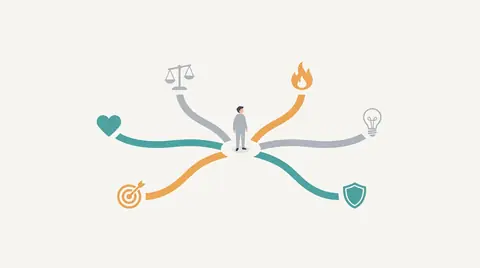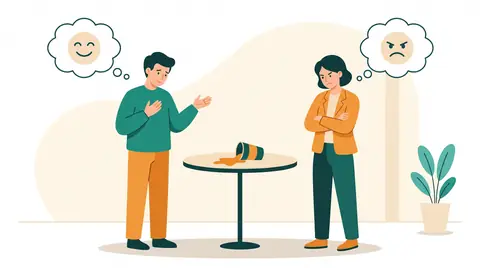


You have two options. Both cost you something. Neither is clearly right. You have probably felt this more times than you can count, standing between a promise and a friend in need, or between telling the truth and keeping the peace.
That feeling has a name: a dilemma. The word is used loosely for any hard choice, but it means something more specific, and understanding it can make the hard choices a little easier to think through.
What does dilemma mean?
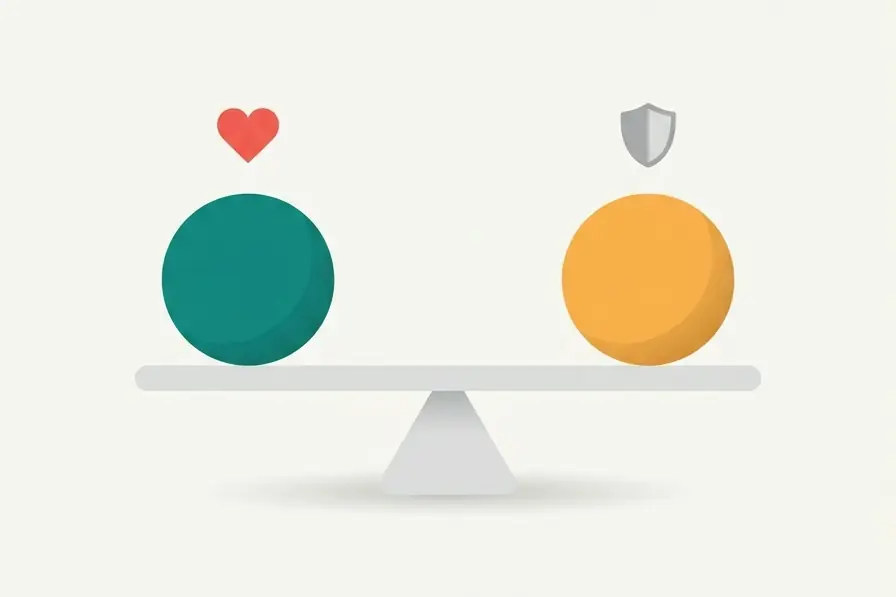
A dilemma is a situation where you must choose between two (or more) options, and every option has a real downside. It is not just a difficult decision. It is a decision where something you care about will be given up whichever way you go.
The word comes from Greek: di means "two" and lemma means "premise" or "assumption". Originally it described an argument that traps you between two propositions, both leading to an uncomfortable conclusion. Today we use it for the everyday version: two paths, no free one.
A hard choice has a better answer you haven't found yet. A dilemma has no answer that costs nothing.
Dilemma vs. problem vs. hard choice
- A problem has a solution. Your car won't start; you find out why and fix it.
- A hard choice has a best answer that takes effort to find. Two job offers, one clearly better once you compare the details.
- A dilemma stays hard even with all the facts. You know exactly what each option costs, and you still have to pick which loss you can live with.
That is why more information rarely settles a true dilemma. What settles it is your values: which of the two good things matters more to you in this moment.
Common types of dilemma (with examples)
Moral dilemma. Two moral values point in opposite directions. Example: a seriously ill relative asks whether two family members who fell out have made peace. They haven't. Honesty says tell the truth; kindness says give them comfort. More examples: 7 everyday moral dilemma examples.
Ethical dilemma at work. Professional duties clash with personal loyalty or company pressure. Example: your manager tells you not to mention that a client paid an invoice twice. See 7 ethical dilemmas at work.
Relationship dilemma. Honesty, trust and your own needs pull against each other. Example: an ex you haven't spoken to in years asks to catch up, and you are happily committed. Do you tell your partner first? See 7 relationship dilemmas.
Family dilemma. Duty to the people who raised you meets the life you want for yourself. Example: your family expects a stable career, and you are drawn to something riskier. See 7 family obligation dilemmas.
Friendship dilemma. Loyalty to one friend conflicts with honesty to another. Example: a friend tells you they plan to end their relationship, and their partner, also your friend, asks you if something is wrong. See 7 friendship dilemmas.
Parenting dilemma. Protecting a child conflicts with letting them learn. Example: their school project is due tomorrow, half done, and they are exhausted. See 7 parenting dilemmas.
Money dilemma. Fairness and friendship collide over amounts too small to fight about and too big to ignore. See 7 money and friendship dilemmas.

Watch out for the false dilemma
Not everything that feels like a dilemma is one. A false dilemma (also called a false dichotomy) is when a situation is presented as having only two options when more exist. "Either you take this job or your career is over." "Either you agree with me or you don't respect me."
Before you agonise over two painful options, ask: is there a third way? Could you delay, split the difference, ask for more time, or change the question? Many real dilemmas shrink once you notice the options someone else left off the table.
How to think through a real dilemma
- Name the two values in conflict. Not the two options, the two things you care about: honesty and kindness, loyalty and fairness, freedom and duty.
- Check it is not a false dilemma. List every option, including the uncomfortable or unusual ones.
- Ask which loss you can live with. Imagine yourself a year from now. Which choice would you be able to explain to yourself?
- Notice whose opinion you are imagining. Sometimes the choice that feels "right" is just the one that avoids someone's disapproval.
- Accept that it will still cost something. Feeling uneasy after a dilemma does not mean you chose wrong. It means you gave up something that mattered.
What your dilemmas say about you
Because a dilemma has no free answer, the way you resolve it is revealing. Two thoughtful people can face the same situation and choose opposite paths, not because one is wiser, but because they rank their values differently. Some people reach for honesty first, others for harmony. Some protect fairness, others protect the relationship.
That is the idea behind ThinkAlike's short interactive stories. Instead of asking you to describe yourself, they put you inside everyday dilemmas and let your choices build a picture of how you think. If you are curious, start with 7 everyday dilemmas with no right answer, or read how a thinking style test without questions works.